A
C
M
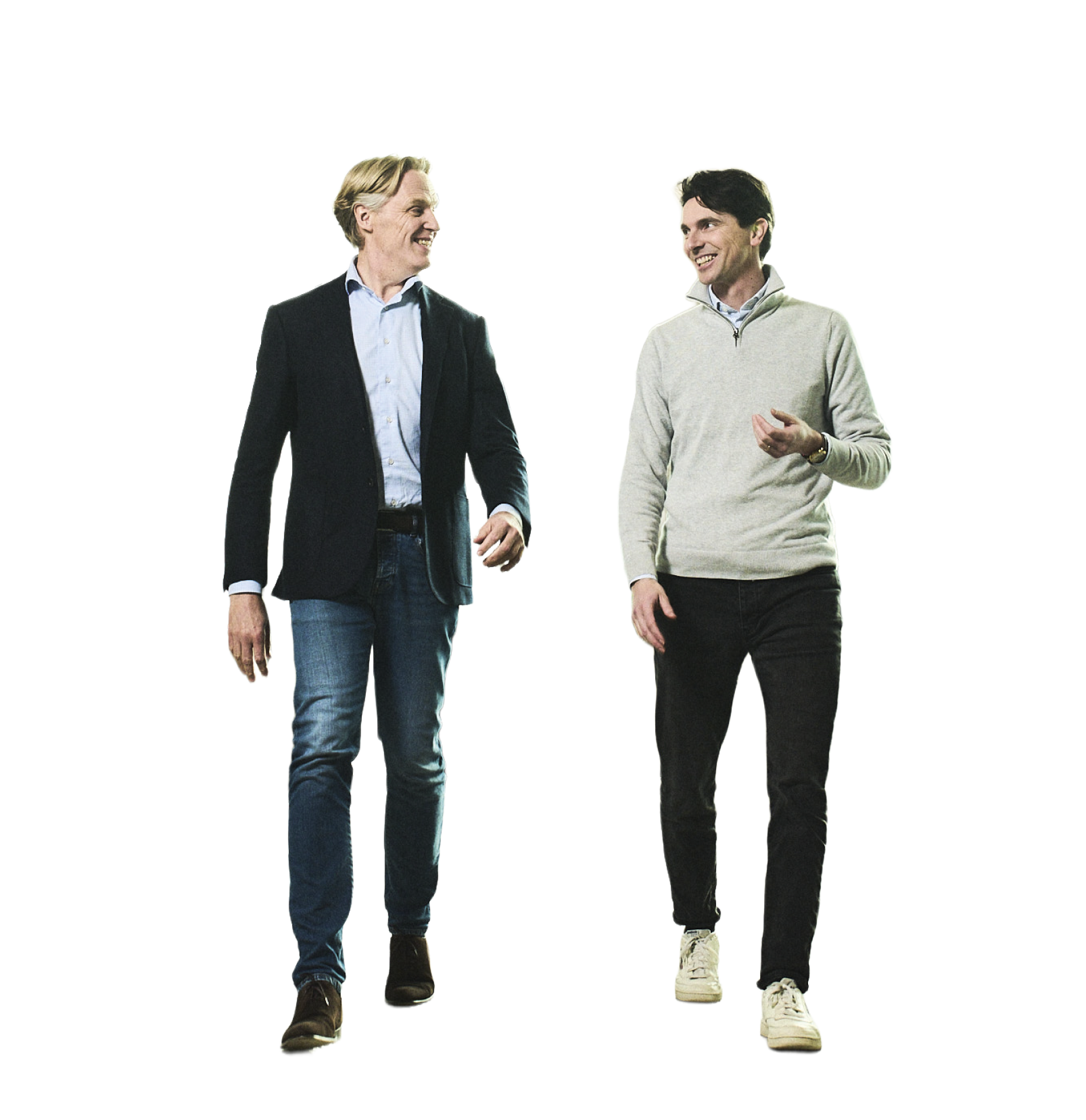
Marc van Breda
(54), Director of Legal & Regulatory Affairs
Lucas Tordoir
(36), Manager Legal News Media, Magazines & Online Services
Audio & video
How approval for the RTL acquisition was secured after eighteen months of investigation and more than 250 questions
An
exercise
in
patience
The process surrounding the acquisition of RTL Nederland took eighteen months. During that time, two in-house lawyers at DPG Media, Marc van Breda and Lucas Tordoir, had to walk a tightrope – but one they also enjoyed.
Christian Van Thillo had long spoken of one particular ambition: a television channel in the Netherlands. That became RTL, whose Videoland streaming service may be even more important than its TV channels. Patience was needed – a great deal of patience. The Authority for Consumers & Markets (ACM) spent eighteen months investigating the consequences of the acquisition.
“That is indeed a long time,” says Director of Legal & Regulatory Affairs Marc van Breda. “Despite the limited overlap between RTL’s activities and those of DPG Media, it is understandable that the ACM needed time to carefully examine the acquisition of RTL, which brings together all media types – news media, magazines, radio, television, streaming and online – within a single company. That also made this, for us, after the acquisitions of Wegener and Sanoma, a unique experience.”

“We did have a glass of champagne.
But we only had fifteen minutes to celebrate.”

Marc looks back on the process with satisfaction. So does Lucas Tordoir, who at the time was Senior Legal Counsel and is now Manager Legal News Media, Magazines & Online Services. Lucas says: “You can hardly influence the process, let alone control it, and you receive highly detailed questions at the most inconvenient moments – on a Friday afternoon, for example. The ACM works in a very distinctive way, at a pace of its own choosing, but always with highly qualified professionals.”
Questions, questions, questions. More than 250 in all. At its core, the ACM is concerned with one question above all: will the companies together become too powerful in the markets in which they operate? The ACM’s investigation focuses on the consequences for consumers. Is there a risk prices for products or services will rise sharply, or that their quality will decline?
Concerns among competitors
As part of its investigation the ACM consulted, among others, competitors and representative organisations. Mediahuis, NPO, Talpa, Het Financieele Dagblad, ANP, NOS and the journalists’ union NVJ all expressed concerns about the consequences of the acquisition. Some objections raised included that advertisers would no longer be able to avoid DPG Media, that DPG Media would become too powerful as an employer and client for journalists, and that it would gain such a strong negotiating position that it could impose its will on the ANP news agency.
Intensive investigation
The investigation was extremely thorough. The ACM spoke to almost forty stakeholders and even sent four of its own staff to Qmusic and JOE for two full days to observe the sale of advertising at close quarters. The ACM also interviewed several editors-in-chief. Even contract negotiations with ANP from years ago had to be produced. The same applied to the course of collective labour agreement negotiations and the development of employment conditions from 2010 onwards. But on all these points, the objections were rejected. In all these areas, sufficient competition or countervailing power would remain, the ACM concluded.
In the end, the investigation focused on one question: would DPG Media gain too strong a position as a provider of general online news? Would consumers be worse off if the owner of AD, NU.nl, de Volkskrant and Trouw also became the owner of RTL Nieuws?
Marc says: “The ACM included media plurality in its investigation, partly on the advice of the Dutch Media Authority. NU.nl and rtlnieuws.nl – platforms that depend on advertising rather than subscription revenue – could, for example, start taking over articles from one another in areas such as sport or economics, which would make the company more efficient but reduce the diversity of online news provision. In doing so, the ACM was entering uncharted territory. But we understood why it wanted to examine this, given the crucial role that a pluralistic news offering plays in our democratic society.”
“A pluralistic news service plays a crucial role in our democratic society”
New editorial statutes
To secure approval for the acquisition, DPG Media committed, among other things, to ensuring that NU.nl and rtlnieuws.nl, two free online news brands, would remain separate and that two foundations would be established to oversee that separation, among other responsibilities. In addition, the editorial statutes would be updated.
Lucas says: “Updating the editorial statutes applied to all thirteen news titles in the Netherlands, including those in Middelburg, Enschede and Eindhoven. That was far from unnecessary, because most of the statutes were seriously outdated. In some cases, the words ‘digital’ or ‘online’ did not even appear. Based on ten points, such as the procedure for appointing the editor-in-chief and safeguarding editorial independence, we agreed with the ACM to update the editorial statutes. We were given exactly six months to revise them together with our newsrooms. We succeeded.”
A good home
The document in which the ACM recorded its ‘Provisional Findings’ on 7 May 2025 ran to ninety pages. Its message was clear: DPG Media is a good home for journalism, and the commitments are appropriate and workable.
Interested parties were then given the opportunity to respond – not only in writing. The ACM decided to hold a hearing, at which all parties, together with their lawyers and economists, were able to make their views heard one more time. Marc says: “That too was very special, even for the lawyers from Loyens & Loeff and the economists from RBB who advised us. Just imagine it: an hours-long hearing with around forty people in a room full of opposing views. But with a clear agenda and under the firm guidance of the ACM, it led to a good substantive discussion. In some respects, it also led to adjustments to our commitments. Initially, NU.nl and rtlnieuws.nl would have had to remain freely accessible for ten years; after the hearing, that was extended indefinitely.”
The hearing took place on 26 May, DPG Media signed all agreed conditions on 20 June, and on 27 June the press release went out – eighteen months after the announcement that DPG Media intended to acquire RTL. Lucas says: “We did have a glass of champagne. But we only had fifteen minutes to celebrate. Then we got straight back to work.”

